On this page
- 01Key takeaways
- 02What is a headless website?
- 03How much does a headless website cost?
- 04What does headless give you?
- 05Why do most small businesses not need headless?
- 06When is headless worth it?
- 07What does this look like in practice?
- 08Headless decision checklist
- 09Next step
- 10Sources and further reading
- 11Frequently asked questions
Key takeaways
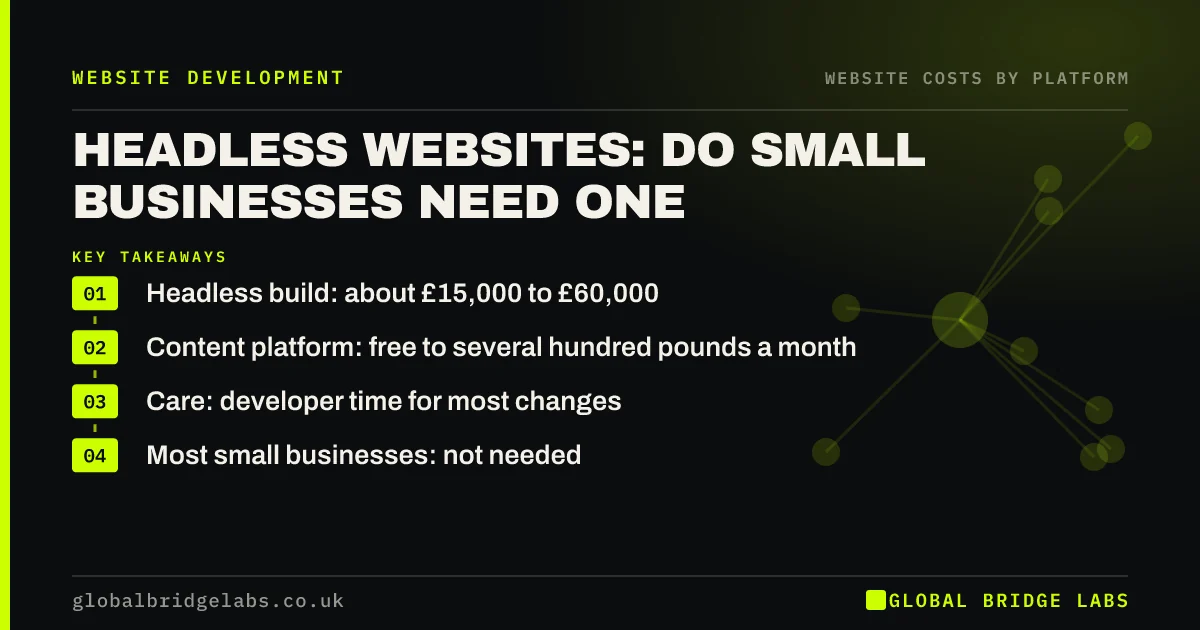
A headless website typically costs £15,000 to £60,000 to build, plus content platform fees and developer care. Headless separates content management from the front end, which can bring speed and flexibility. For most UK small businesses it is unnecessary: a well-built standard site gives similar results for a fraction of the cost and effort.
- Headless build: about £15,000 to £60,000.
- Content platform: free to several hundred pounds a month.
- Care: developer time for most changes.
- Most small businesses: not needed.
Want to know if headless makes sense for you? Message us on WhatsApp.
Chat on WhatsApp →What is a headless website?
A headless website is a site where the content management system stores and serves content, while a separate front end built by developers displays it. The two connect through an interface rather than one system doing both. It allows custom front ends and multiple channels from one content source.
How much does a headless website cost?
A headless website typically costs £15,000 to £60,000 to build for a UK business, based on agency quotes, because it needs developers for both the content model and the front end. Running costs include content platform subscriptions, front-end hosting and developer care for most changes.
- Build: about £15,000 to £60,000.
- Content platform: free tiers to several hundred pounds a month.
- Front-end hosting: often £0 to £100 a month.
Want a headless quote compared with a standard build? Message us on WhatsApp and we will discuss your requirements.
Chat on WhatsApp →What does headless give you?
Headless can give fast pages, design freedom and the ability to publish the same content to a website, app and other channels. When built well, it can score strongly on Core Web Vitals. Search engines can index it, but JavaScript-heavy builds need care for Google to render pages properly.
Why do most small businesses not need headless?
Most small businesses do not need headless because they have one website, a small team and simple content. A standard WordPress, Webflow or builder site can be fast and accessible at a fraction of the cost, and non-technical staff can edit it without developers.
When is headless worth it?
Headless is worth it when you publish to several channels, need a custom app-like front end, or have developers in-house who will maintain it. It can also suit high-traffic online stores where every millisecond of speed matters.
What does this look like in practice?
At Global Bridge Labs (GBL), a UK property consultancy was quoted £35,000 for a headless rebuild to fix a slow site. An audit showed the slowness came from images and a heavy theme. Fixing those on their existing platform cost about £3,000 and brought the site into the good range for Core Web Vitals.
Headless decision checklist
- List the channels you publish to.
- Check who will maintain the front end.
- Compare with a fast standard build.
- Ask how editors will preview content.
- Check how pages are rendered for search.
- Price developer care for routine changes.
Next step
If speed is the reason you are considering headless, run a speed audit on your current site first. The fix is often far cheaper.
Message us on WhatsApp for a headless vs standard comparison, or book a 30-minute consultation.
Chat on WhatsApp →Sources and further reading
- Understanding Core Web Vitals and Google search results · Google Search Central
- Understand JavaScript SEO basics · Google Search Central
- Web Vitals: essential metrics for a healthy site · web.dev (Google)
Frequently asked questions
How much does a headless website cost?
A headless website typically costs £15,000 to £60,000 to build in the UK, plus content platform fees, front-end hosting and developer care. Costs are higher than standard sites because developers build both the content model and a custom front end, and routine changes often need developer time.
Is a headless website better for SEO?
Not automatically. A headless site can be very fast, which helps, but if pages rely heavily on JavaScript, search engines may struggle to render them. A well-built standard site can perform just as well in search. SEO depends more on content, speed and structure than architecture.
Do small businesses need a headless CMS?
Rarely. Most small businesses have one website and a small team, and a standard content management system is cheaper to build and easier to edit. Headless makes sense when publishing to several channels, building app-like experiences or employing developers who will maintain it.
Written by

Global Bridge Labs (GBL) is a UK–Sri Lanka partner for social media, websites and BPO. Everything here comes from client delivery, not theory.