On this page
- 01Key takeaways
- 02How do the worked examples work?
- 03Which examples justified the premium?
- 04Which examples did not justify it?
- 05When do premiums usually pay back?
- 06When do premiums usually fail to pay back?
- 07What does this look like in practice?
- 08Worked example checklist
- 09Next step
- 10Sources and further reading
- 11Frequently asked questions
Key takeaways
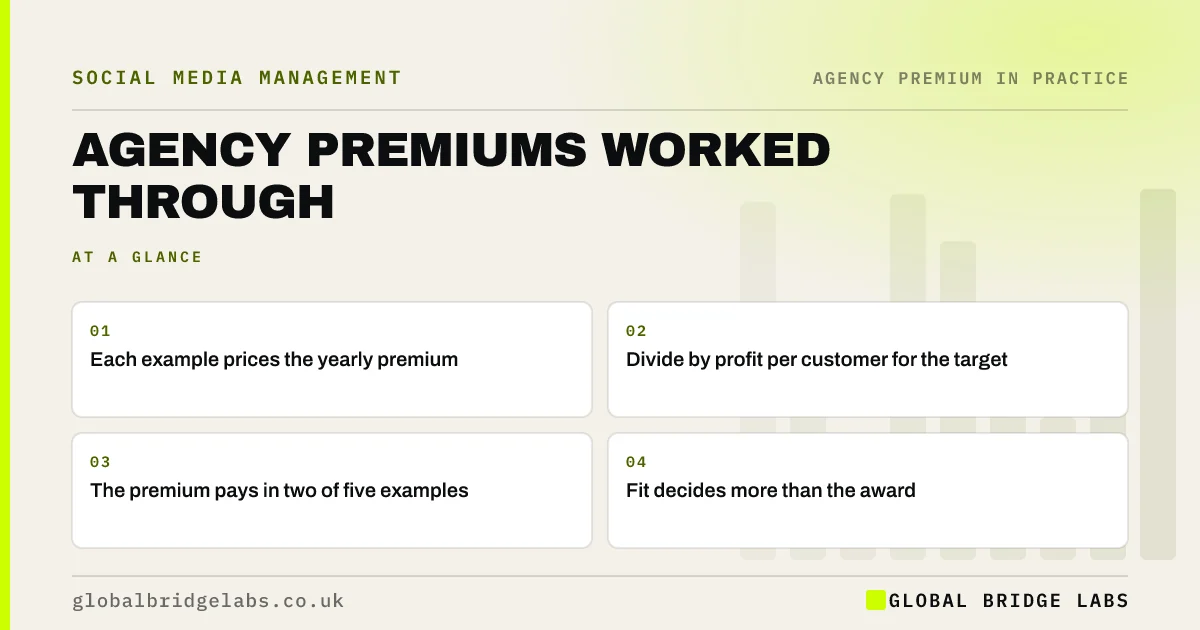
These five worked examples show how to judge an agency premium in pounds. In each, the yearly premium is divided by the profit from one extra customer to show how many extra customers the dearer agency must win. The premium makes sense in two of the five, and only where the agency's strengths match the need.
- Each example prices the yearly premium.
- Divide by profit per customer for the target.
- The premium pays in two of five examples.
- Fit decides more than the award.
Want your own numbers worked through? Message us on WhatsApp.
Chat on WhatsApp →How do the worked examples work?
Each example compares two proposals, works out the yearly premium and divides it by the profit from one extra customer. That gives the number of extra customers the dearer agency must win to break even. Then we ask whether its strengths make that number plausible. Figures are illustrative, not client data.
Which examples justified the premium?
Two did. An online skincare brand paid £1,500 a month more, £18,000 a year, for an agency with proven creative testing; with £60 profit per order, it needed 300 extra orders a year, which its ad volume made realistic. A clinic group paid £1,000 more for healthcare experience that cut compliance delays.
- Ecommerce brand: £18,000 premium, 300 orders needed.
- Clinic group: experience saved weeks of approvals.
Which examples did not justify it?
Three did not. A local plumber faced a £1,200 monthly premium, needing many extra jobs a year. An accountancy practice would have paid for creative awards it did not need. A startup would have spent runway on polish before knowing its audience. In each, a better-fitting agency won.
- Local trade: premium too large for job values.
- Accountancy: awards unrelated to the need.
- Startup: polish before message testing.
Want help working through your own example? Message us on WhatsApp and we will discuss your requirements.
Chat on WhatsApp →When do premiums usually pay back?
Premiums usually pay back when customer values or volumes are high, results are trackable and the agency's specific strength matches your main gap.
When do premiums usually fail to pay back?
They usually fail when customer values are low, needs are routine or the award relates to work you do not need.
What does this look like in practice?
A pattern we see: once buyers put the premium into customers needed, the decision often becomes obvious within minutes, either because the number is easily achievable or clearly unrealistic.
Worked example checklist
- Find the monthly difference.
- Multiply by twelve.
- Work out profit per customer.
- Divide to get customers needed.
- Judge whether that is plausible.
Next step
Run your own example with your two leading proposals and your real profit per customer.
Message us on WhatsApp for a worked comparison, or book a 30-minute consultation.
Chat on WhatsApp →Sources and further reading
- Earnings and hours worked, occupation by four-digit SOC: ASHE Table 14 · Office for National Statistics
- About key events · Google Analytics Help
- IPA Effectiveness Awards · IPA
Frequently asked questions
How do I calculate an agency premium?
Subtract the cheaper agency's monthly fee from the dearer one, then multiply by twelve to get the yearly premium. Divide that by the profit from one extra customer. The result is how many extra customers the dearer agency must produce each year just to cover its higher fee.
Are the worked examples real clients?
No. They are illustrative examples built from typical UK price ranges and common situations, to show the method. Your own numbers will differ. Use your actual fees, hours and profit per customer to work out whether a specific agency premium makes sense for your business.
What profit figure should I use per customer?
Use the gross profit from a typical customer over a sensible period, such as a year or their expected lifetime if you have reliable data. Be conservative. Overestimating customer value makes almost any premium look affordable and can lead to overpaying for an agency.
Written by

Global Bridge Labs (GBL) is a UK–Sri Lanka partner for social media, websites and BPO. Everything here comes from client delivery, not theory.