On this page
- 01Key takeaways
- 02What are the costs of a slow website?
- 03How do you put a number on it?
- 04How does slowness waste advertising spend?
- 05What does the evidence say about scale?
- 06When is a slow website not costing you much?
- 07What does this look like in practice?
- 08Cost of slowness checklist
- 09Next step
- 10Sources and further reading
- 11Frequently asked questions
Key takeaways
The cost of a slow website is the business it loses quietly: visitors who leave before the page appears, ad clicks paid for and never seen, enquiries abandoned at a stalled form and customers who ring instead of using the site. None of it shows on an invoice, which is why it runs for years. A simple sum on your own figures usually shows a monthly loss larger than the one-off cost of the fix.
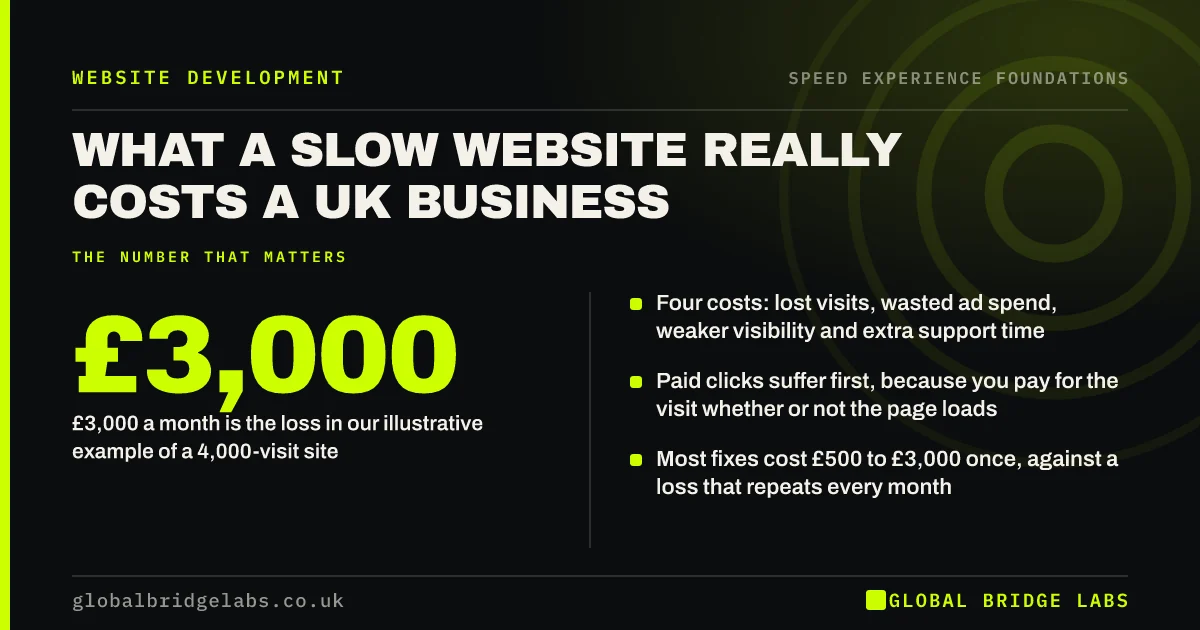
- £3,000 a month is the loss in our illustrative example of a 4,000-visit site.
- Four costs: lost visits, wasted ad spend, weaker visibility and extra support time.
- Paid clicks suffer first, because you pay for the visit whether or not the page loads.
- Most fixes cost £500 to £3,000 once, against a loss that repeats every month.
Want this sum run on your own numbers? Message us on WhatsApp for a costed view.
Chat on WhatsApp →What are the costs of a slow website?
A slow website has four costs, and only one of them is obvious. Lost visits are the visitors who leave during the wait. Wasted spend is the advertising that paid for those visits. Weaker visibility is the effect on search and ad rankings. Extra support is the staff time spent on calls and emails from people who gave up on the site.
- Lost visits: people who never see the page and never enquire.
- Wasted spend: clicks bought from Google or social that bounce on arrival.
- Weaker visibility: slower pages can lose out to similar, faster ones.
- Extra support: customers who phone because the booking or tracking page stalled.
How do you put a number on it?
Work from your own traffic, in four steps. This example is illustrative, and every figure should be replaced with yours.
A site has 4,000 visits a month, 60% on phones: 2,400 mobile visits. Suppose one in five mobile visitors leaves before the first screen appears, which is 480 visits. If the rest enquire at 2%, that is 38 enquiries where there could have been 48. Ten lost enquiries, with one in four becoming a £1,200 job, is 2.5 jobs or about £3,000 a month. If half of that mobile traffic came from ads at £1.50 a click, a further £360 a month was spent on visits that never saw the page.
- 1. Count monthly visits to your key landing pages, by device.
- 2. Estimate the share lost to slow loading from very short sessions.
- 3. Apply your enquiry rate and your enquiry-to-sale rate.
- 4. Multiply by your average job or order value.
Send us your monthly visits and average job value on WhatsApp and we will run the sum with you.
Chat on WhatsApp →How does slowness waste advertising spend?
Slowness wastes ad spend twice. You pay for every click, including the ones that leave before the page loads. And Google Ads rates your landing page experience as part of Quality Score, which influences what you pay per click and where your advert appears. A slow landing page can mean paying more for a worse position.
What does the evidence say about scale?
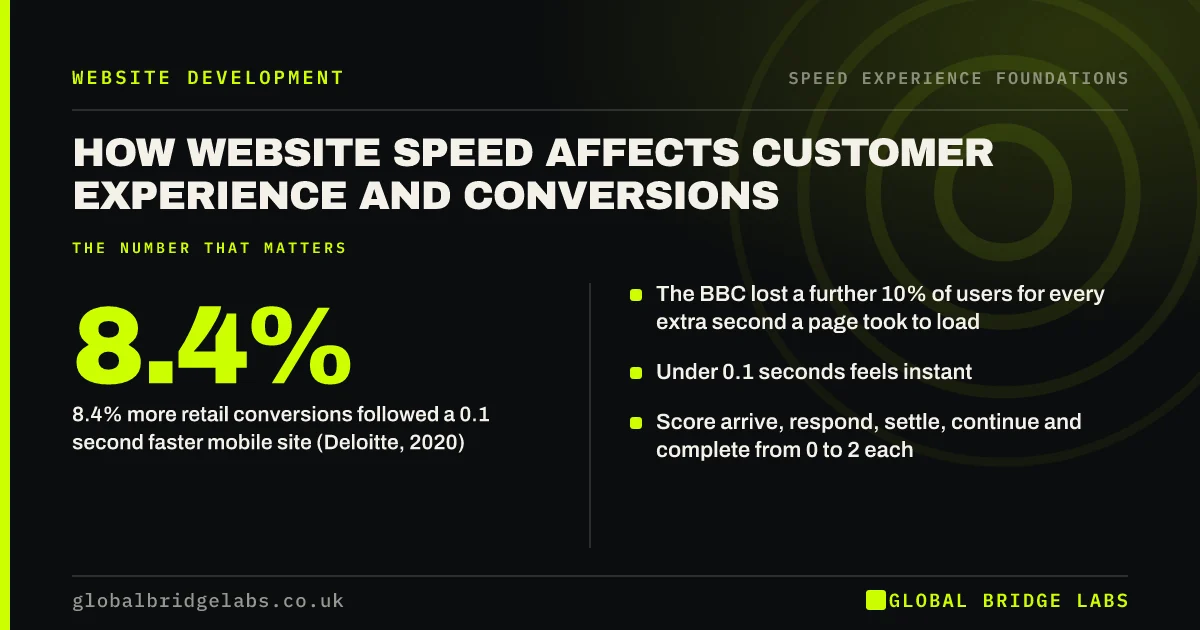
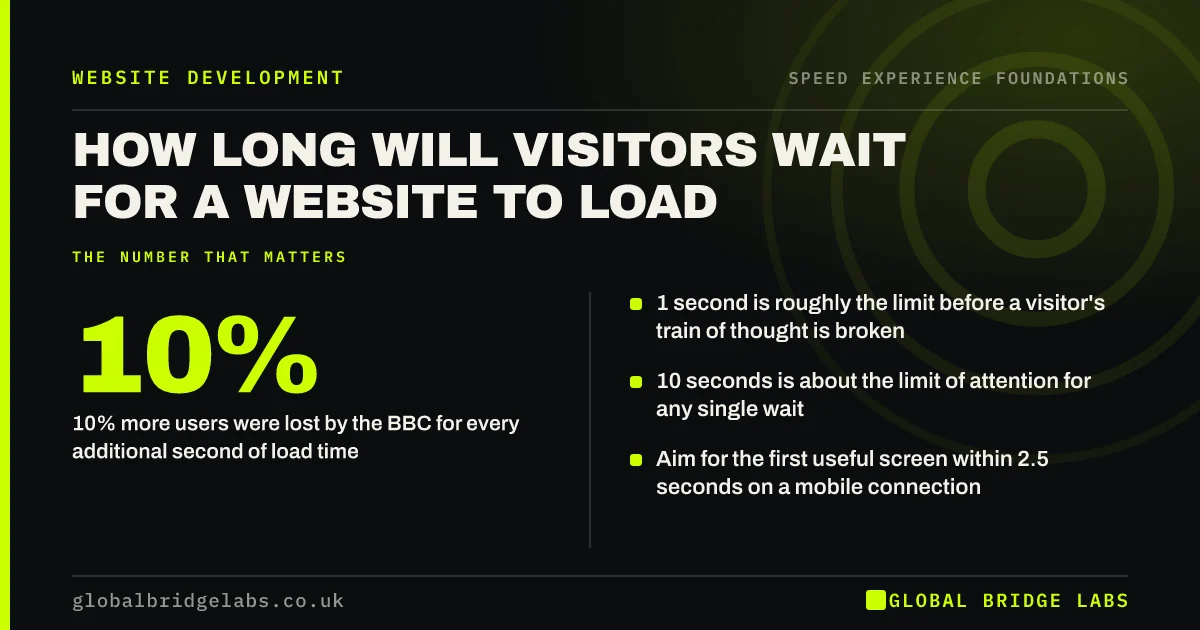
Published studies give a sense of proportion. Deloitte's 2020 Milliseconds Make Millions study found that a 0.1 second improvement in mobile site speed was associated with 8.4% more retail conversions and an 8.3% better bounce rate on lead generation information pages. The BBC found it lost an additional 10% of users for each extra second of load time.
Those are averages across large sites. A small business cannot assume the same percentages, and a sum built on someone else's figure is not a forecast. Use the studies to decide whether the question is worth asking, and your own analytics to answer it.
When is a slow website not costing you much?
A slow website costs little when few visitors arrive cold. If most of your work comes from referrals who look you up by name, they will wait, and the site is confirming a decision already made. The same applies to pages only existing customers use.
It also costs little when the slowness is on pages nobody lands on. Check which pages receive first visits before spending anything. A slow blog archive is a lower priority than a slow service page that receives your ad traffic.
What does this look like in practice?
A pattern we see in firms that advertise: the monthly report shows a healthy click-through rate and a disappointing number of enquiries, and the conclusion is that the adverts are attracting the wrong people. On a phone, the landing page shows a blank screen while a video header and three tracking tags load.
Replacing the video with an image and trimming the tags changes how many paid visitors see the offer at all. Global Bridge Labs (GBL) checks the landing page before the advert for this reason. Across our client work we have seen a 2.4x enquiry rate from conversion changes like these.
Cost of slowness checklist
- List the pages that receive most first visits.
- Split visits by device and by paid or unpaid source.
- Count mobile sessions that end within a few seconds.
- Run the four-step sum with your own conversion and job values.
- Compare the monthly figure with a quote for the fix.
- Re-run the sum three months after the work.
Next step
A slow site is a cost you are already paying. Putting a figure on it turns a technical complaint into a business decision. We will help you work out the figure and what it would take to stop paying it.
Message us on WhatsApp for a costed view of what slow pages are losing you, or book a 30-minute consultation.
Chat on WhatsApp →Sources and further reading
- Milliseconds make millions: mobile site speed and conversion · Deloitte
- Why does speed matter? · web.dev
- About Quality Score for Search campaigns · Google Ads Help
- Engagement rate and bounce rate · Google Analytics Help
Frequently asked questions
How much does a slow website cost a business?
It depends on traffic, conversion rate and order value. In an illustrative example of a site with 4,000 visits a month, losing one mobile visitor in five to slow loading cost about ten enquiries and roughly £3,000 a month. Run the same sum with your own figures before deciding what to spend.
Does a slow website lose customers?
Yes. Visitors who wait too long leave before seeing the offer, and they do not come back to complain. The BBC found it lost an additional 10% of users for every extra second of load time. For a small business, each lost visit is a larger share of the total.
Does a slow website waste Google Ads budget?
Yes, in two ways. You pay for clicks that leave before the page appears, and Google Ads includes landing page experience in Quality Score, which influences cost per click and ad position. Fixing a slow landing page often improves results more cheaply than raising the budget.
Is it cheaper to fix a slow website or live with it?
Usually to fix it. Focused speed work on an existing site is an indicative £500 to £3,000, paid once. The loss from slow pages repeats every month. The exception is a site with little cold traffic, where the cost of slowness is small and the money is better spent elsewhere.
Written by

Global Bridge Labs (GBL) is a UK–Sri Lanka partner for social media, websites and BPO. Everything here comes from client delivery, not theory.