On this page
Key takeaways
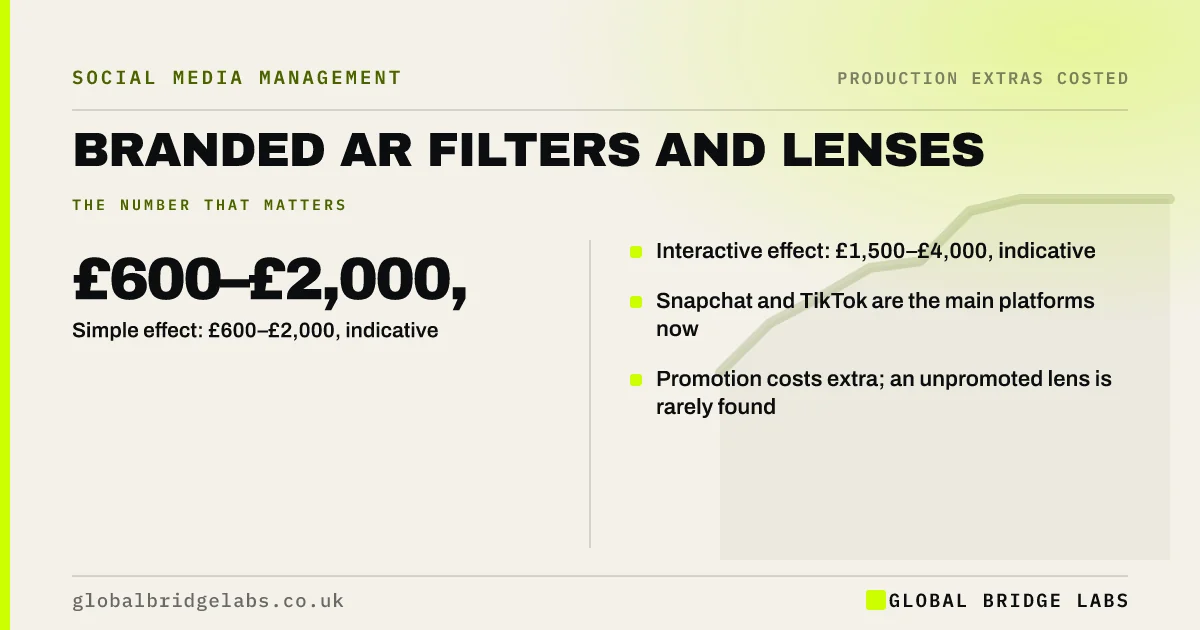
A branded AR filter typically costs an indicative £600–£2,000 for a simple face or frame effect (8 to 20 hours at £75–£100 an hour) and £1,500–£4,000 for an interactive one (20 to 40 hours). Snapchat Lenses and TikTok effects are the main options, since Instagram closed its platform for third-party AR effects in 2025.
- Simple effect: £600–£2,000, indicative.
- Interactive effect: £1,500–£4,000, indicative.
- Snapchat and TikTok are the main platforms now.
- Promotion costs extra; an unpromoted lens is rarely found.
Considering a branded lens? Message us on WhatsApp first.
Chat on WhatsApp →What is a branded AR filter?
A branded augmented reality (AR) filter is a camera effect that overlays your graphics, products or animations on a user's face or surroundings. People use it in their own photos and videos, which spreads your brand through their posts. Snapchat calls these Lenses; TikTok calls them effects.
How much does an AR filter cost?
A simple branded frame or face effect, using existing artwork, takes 8 to 20 hours of design, build and testing, an indicative £600–£2,000. Interactive effects with 3D products, games or try-on take 20 to 40 hours, about £1,500–£4,000. Promoting the effect with ads is a separate budget.
- Frame or face effect: £600–£2,000.
- 3D, game or try-on: £1,500–£4,000.
- Platform review and fixes: included or 1 to 2 hours.
- Paid promotion: separate media budget.
Send us your idea on WhatsApp and we will discuss your requirements.
Chat on WhatsApp →Can you still make Instagram filters?
Not as a business building its own. Meta closed its Spark AR platform in January 2025, and third-party effects were removed from Instagram and Facebook. Branded AR on social now mainly means Snapchat Lenses and TikTok effects. Check each platform's current tools before commissioning work.
When is an AR filter a gimmick?
When there is no reason for people to use it. Filters work for events, launches, sports moments and products people want to try on. A generic logo frame with no event or promotion behind it is rarely used. For most small businesses, the same money does more in content or ads.
What does this look like in practice?
A pattern we see: a business commissions a lens, launches it with one post and sees little use. Tying it to a single event, with a QR code on site and a short paid push, usually produces far more uses than leaving it to be discovered.
AR filter checklist
- Tie the effect to an event or launch.
- Check which platforms your audience uses.
- Use existing brand artwork to cut cost.
- Budget for promotion, not just the build.
- Measure uses and shares, not just impressions.
Next step
Name the moment that would make people want to use your filter. If you cannot, spend the budget elsewhere.
Message us on WhatsApp for a campaign idea check, or book a 30-minute consultation.
Chat on WhatsApp →Sources and further reading
- Snapchat advertising · Snap Inc.
- TikTok for Business · TikTok
Frequently asked questions
How much does a Snapchat Lens cost to make?
A simple branded Lens built from existing artwork costs an indicative £600–£2,000 at UK agency rates. Interactive Lenses with 3D objects or games cost more, about £1,500–£4,000. Promotion is a separate budget.
Can I still make a custom Instagram filter?
No longer through Meta's own tool. Meta closed Spark AR in January 2025 and removed third-party effects from Instagram and Facebook. Snapchat and TikTok still support branded effects.
Do AR filters help small businesses?
Occasionally, for events, launches or products people want to try on. For most small businesses, the same budget produces more enquiries through regular content or targeted ads.
Written by

Global Bridge Labs (GBL) is a UK–Sri Lanka partner for social media, websites and BPO. Everything here comes from client delivery, not theory.