On this page
- 01Key takeaways
- 02What counts as a bad hire?
- 03What does a bad hire cost?
- 04What does a worked example look like?
- 05How do you reduce the risk of a bad hire?
- 06What are the rules if a hire is not working?
- 07How does outsourcing change the risk?
- 08What are the early warning signs of a bad hire?
- 09What does this look like in practice?
- 10Bad hire checklist
- 11Next step
- 12Sources and further reading
- 13Frequently asked questions
Key takeaways
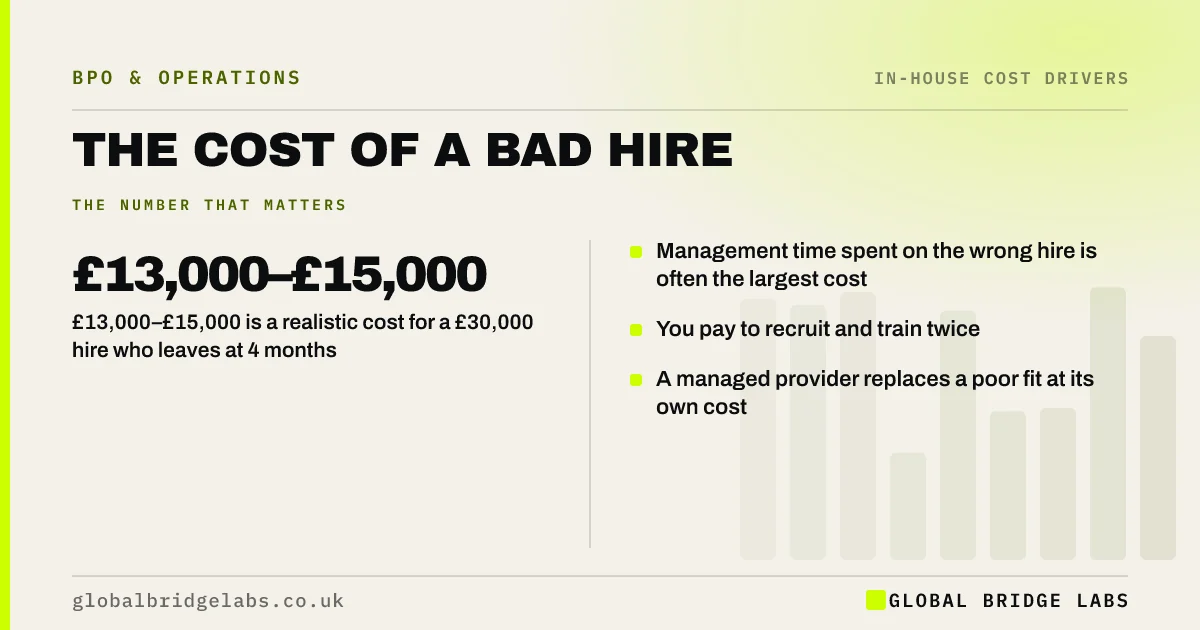
The cost of a bad hire is the pay for low output, the management time spent on it, the cost of rehiring and any damage to customers. For a £30,000 hire who leaves after four months, a realistic total is about £13,000–£15,000. Small businesses feel it most because one person is a large share of capacity.
- £13,000–£15,000 is a realistic cost for a £30,000 hire who leaves at 4 months.
- Management time spent on the wrong hire is often the largest cost.
- You pay to recruit and train twice.
- A managed provider replaces a poor fit at its own cost.
Worried about the risk of a bad hire? Message us on WhatsApp to compare options.
Chat on WhatsApp →What counts as a bad hire?
A bad hire is someone whose performance, reliability or fit falls short enough that they leave or are let go within the first months, or stay while underperforming. The cost is not only their pay; it is everything the business spends and loses because the role is not working.
What does a bad hire cost?
Count each of these parts.
- Pay for output that did not arrive.
- Recruitment and training that must be repeated.
- Management time on coaching, reviews and exit.
- Colleagues' time fixing errors and covering gaps.
- Customer impact: complaints, lost sales, refunds.
What does a worked example look like?
A £30,000 hire costs about £34,463 a year in employment costs, or about £11,500 over four months. If half of that output is lost, that is £5,700. Add 40 hours of manager time at £40, £1,600, recruiting again at about £1,400 direct, and training the replacement at about £4,000. With rework, the total is about £13,000–£15,000.
Want the risk of a bad hire factored into your comparison? Send us the role on WhatsApp.
Chat on WhatsApp →How do you reduce the risk of a bad hire?
Test the actual work before you hire: a short paid task, a live scenario or a trial of real emails. Check references by phone, be specific about what good looks like in the first 90 days, and review progress weekly in the first month so problems surface early.
- Use a work sample, not just an interview.
- Write down what success looks like at 30, 60 and 90 days.
- Check references by phone with specific questions.
- Review weekly in the first month.
What are the rules if a hire is not working?
Follow a fair, documented process: set expectations, give feedback and time to improve, and follow your contract and disciplinary procedure. GOV.UK's guidance on dismissing staff explains the employer's duties, including notice. Take advice before dismissing if you are unsure.
How does outsourcing change the risk?
With a managed provider, a poor fit is the provider's problem to fix. It replaces the team member and trains the replacement within its rate, and the service level still applies. You are buying an outcome, not taking the hiring risk on one individual.
What are the early warning signs of a bad hire?
Problems usually show within the first four to six weeks. Acting early, with clear feedback and support, either fixes the issue or shortens the cost if it cannot be fixed.
- The same questions asked repeatedly after training.
- Missed deadlines on simple, well-defined tasks.
- Errors that colleagues have to fix.
- Poor reliability: lateness or unexplained absence.
What does this look like in practice?
A pattern we see in UK trades businesses: an office administrator is hired in a rush during a busy season, struggles with the job management system and leaves after three months. The owner covers the office again, then repeats the hiring. A managed team for calls and admin removes that single-hire risk.
Bad hire checklist
Use these steps to limit the risk.
- Define the first 90 days of the role in writing.
- Use a real work sample in selection.
- Check references by phone.
- Review weekly in month one.
- Know your fair process before you need it.
Next step
Tell us the role you are hiring for. We will compare the cost and risk of a hire with a managed team in a 30-minute call.
Message us on WhatsApp to compare hiring risk, or book a 30-minute consultation.
Chat on WhatsApp →Sources and further reading
- Dismissing staff · GOV.UK
- Employment contracts and conditions: notice periods · GOV.UK
- Rates and thresholds for employers 2026 to 2027 · HM Revenue & Customs
Frequently asked questions
How much does a bad hire cost a UK small business?
For a £30,000 hire who leaves after four months, lost output, management time, repeated recruitment and training the replacement typically add up to around £13,000–£15,000. Customer impact, colleagues' time spent fixing errors and lower team morale can push the real cost higher.
How can I avoid a bad hire?
Test the real work with a short paid task, define what success looks like at 30, 60 and 90 days, check references by phone with specific questions, and review weekly in the first month so problems appear early while they can still be fixed or the hire ended fairly.
Does outsourcing remove bad hire risk?
It moves it to the provider. A managed provider replaces and retrains a poor fit within its rate while the agreed service level still applies, so you are not carrying the cost of one person's performance or restarting recruitment yourself each time someone does not work out.
What should I do if a new hire is not working out?
Give clear, specific feedback early, agree what needs to change and by when, and offer support such as extra training. If performance does not improve, follow your contract and a fair, documented process. GOV.UK's guidance on dismissing staff sets out the employer's duties.
Written by

Global Bridge Labs (GBL) is a UK–Sri Lanka partner for social media, websites and BPO. Everything here comes from client delivery, not theory.