On this page
- 01Key takeaways
- 02How do agencies price several locations?
- 03What does each location add?
- 04One brand page or a page for every site?
- 05What should be centralised and what stays local?
- 06How should paid budgets be split?
- 07When does the per-location model not make sense?
- 08How should results be reported across sites?
- 09What does this look like in practice?
- 10Multi-location cost checklist
- 11Next step
- 12Sources and further reading
- 13Frequently asked questions
Key takeaways
Multi-location social media management cost in the UK is usually a central fee plus an amount per location. The central fee covers brand content and reporting. As an indication, each location adds about £150–£500 a month for local posts, its Google Business Profile and replies.
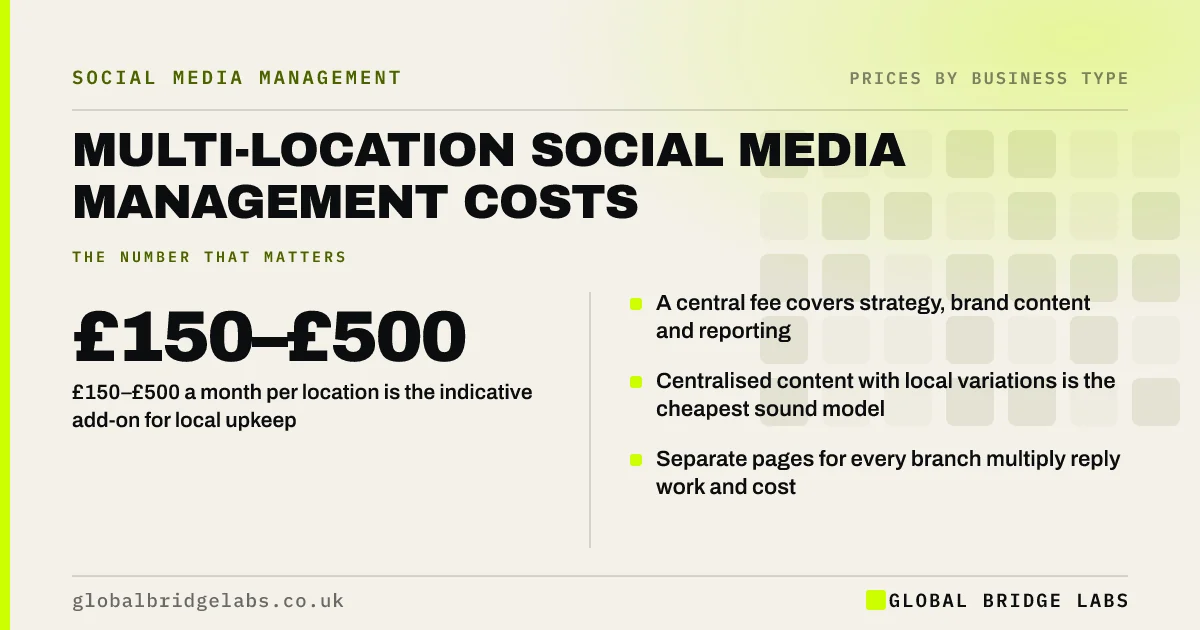
- £150–£500 a month per location is the indicative add-on for local upkeep.
- A central fee covers strategy, brand content and reporting.
- Centralised content with local variations is the cheapest sound model.
- Separate pages for every branch multiply reply work and cost.
Running several sites and unsure how to structure the spend? Message us on WhatsApp.
Chat on WhatsApp →How do agencies price several locations?
Agencies price multi-location work in two layers. The first is a brand-level retainer for strategy, shared content and reporting. The second is a per-location amount for local posts, the local Google Business Profile and replies to local comments, reviews and messages.
What does each location add?
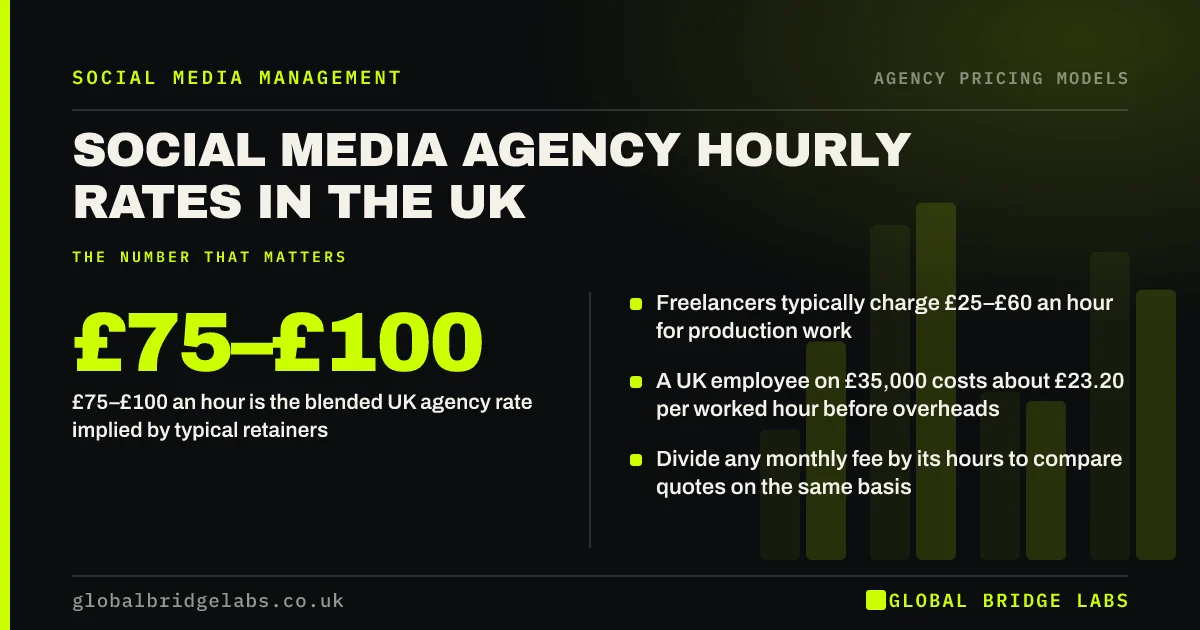
Each location adds 2 to 5 hours a month of local work. At the £75–£100 an hour implied by typical UK retainers, that is about £150–£500 per location, on top of a brand retainer that for most SMEs sits within £950–£2,500. These are indicative figures, not a GBL price list.
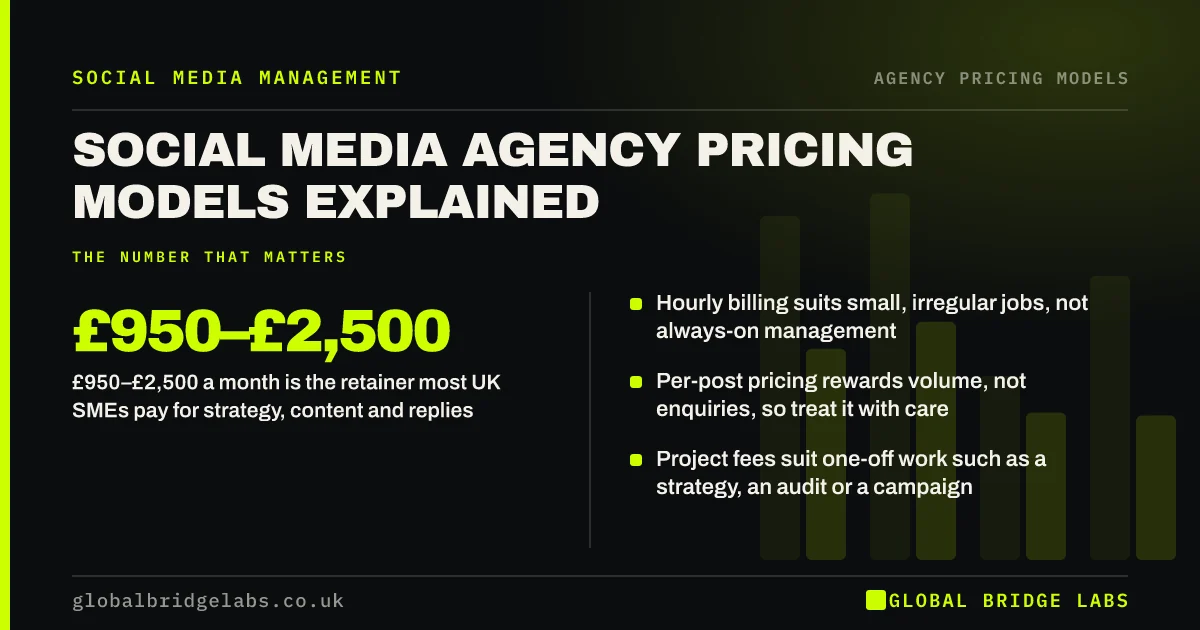
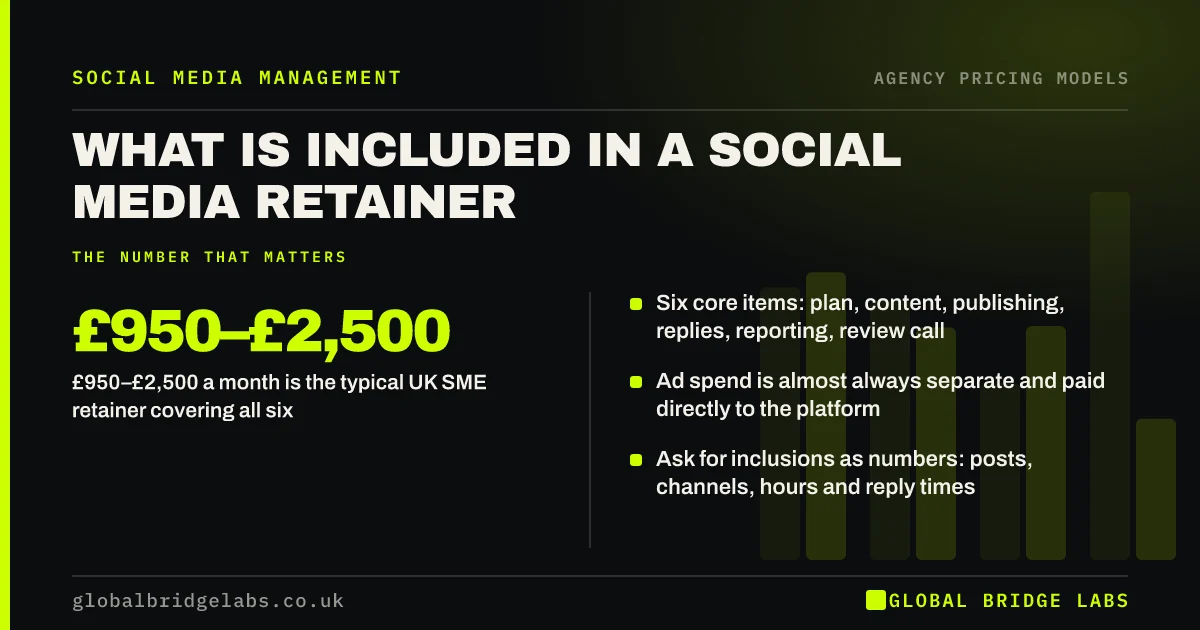
- Brand retainer: within £950–£2,500 a month for most SMEs.
- Per location: indicative £150–£500 a month.
- Local paid campaigns: a separate budget for each area.
- Volume discounts: common above a handful of sites.
Want a central fee and per-location cost worked out? Send us your number of sites on WhatsApp and we will discuss your requirements.
Chat on WhatsApp →One brand page or a page for every site?
One brand page with location details is cheaper and easier to keep consistent. Separate pages suit businesses where each site has its own events, staff and customers, such as restaurants or clinics. Every extra page is another inbox, so only create pages you can staff.
What should be centralised and what stays local?
Centralise the strategy, brand templates, campaigns and reporting. Keep local the things only the site knows: photos of the team and work, local offers, opening changes and replies to local reviews. A shared folder for each site makes local supply simple.
- Central: strategy, templates, campaigns, reporting, approvals.
- Local: photos, offers, events, hours, review replies.
- Shared: a monthly call and a folder per site.
How should paid budgets be split?
Split paid budgets by location so each area gets enough to learn from. A local campaign needs about £300–£500 a month to produce readable results. Spreading one small budget across ten areas leaves every campaign too thin to judge.
When does the per-location model not make sense?
It does not make sense when locations are identical and customers do not care which site they use, such as an online-first brand with collection points. In that case one brand presence and accurate local listings are enough.
How should results be reported across sites?
Report by location as well as in total. A combined figure hides the site that is struggling and the one that is thriving. One page per site, with the same few numbers, lets managers compare and lets you move budget to where it works.
- Local reach and profile views.
- Reviews received and answered.
- Messages and enquiries by site.
- Calls, direction requests and bookings from the profile.
What does this look like in practice?
A pattern we see with UK hospitality and clinic groups: the brand page is active and the local Google profiles are neglected, with wrong hours and unanswered reviews. A small monthly amount per site to keep listings accurate and reviews answered is often the best-value line in the budget.
Multi-location cost checklist
Agree these with any agency.
- Central fee and what it covers.
- Per-location fee and what it covers.
- Who supplies local photos and news.
- Who replies to local reviews and messages.
- Paid budget for each area.
- Reporting by location.
Next step
Tell us how many sites you have and how different they are. We will suggest what to centralise and what each site needs.
Message us on WhatsApp for a multi-location plan, or book a 30-minute consultation.
Chat on WhatsApp →Sources and further reading
- Google Business Profile Help · Google
- Tips to improve your local ranking on Google · Google Business Profile Help
- Meta Business Help Centre · Meta
Frequently asked questions
How much does multi-location social media management cost?
Usually a brand-level retainer, which for most UK SMEs sits within £950–£2,500 a month, plus an indicative £150–£500 a month per location for local posts, the Google Business Profile and replies. Local advertising is budgeted separately for each area.
Does each branch need its own social media page?
Not always. One brand page is cheaper and more consistent. Separate pages suit sites with their own events, teams and customers. Each needs its own Google Business Profile either way. Only open pages you can keep answering.
How do franchises split social media costs?
Commonly the franchisor pays for brand content and strategy, and each franchisee pays a local amount for local posts, listings and advertising in its own area. The split should be written into the franchise marketing agreement. Agree who approves local posts.
Is there a discount for managing many locations?
Often, yes. Shared templates and reporting reduce the work per site, so many agencies lower the per-location amount as the number of sites grows. Ask for the price at your current and planned number of sites. Check what the per-location amount still includes.
Written by

Global Bridge Labs (GBL) is a UK–Sri Lanka partner for social media, websites and BPO. Everything here comes from client delivery, not theory.